The Most Beautiful Places in Brno: A Guide to Main Sights and Hidden Gems
You'll find Brno's main sights on your first day, but the places that make Brno interesting are often a little off the beaten path – underground, at viewpoints outside the center, or in hidden corners not marked by any sign. Our guide combines well-known landmarks with tips that not every list of top places in Brno will reveal.
If you only have one day, choose three to four places. If you're staying longer, use this text as a map to plan your route based on what interests you – architecture, views, history, or perhaps tranquil parks.
PETROV
The landmark defining the city's skyline
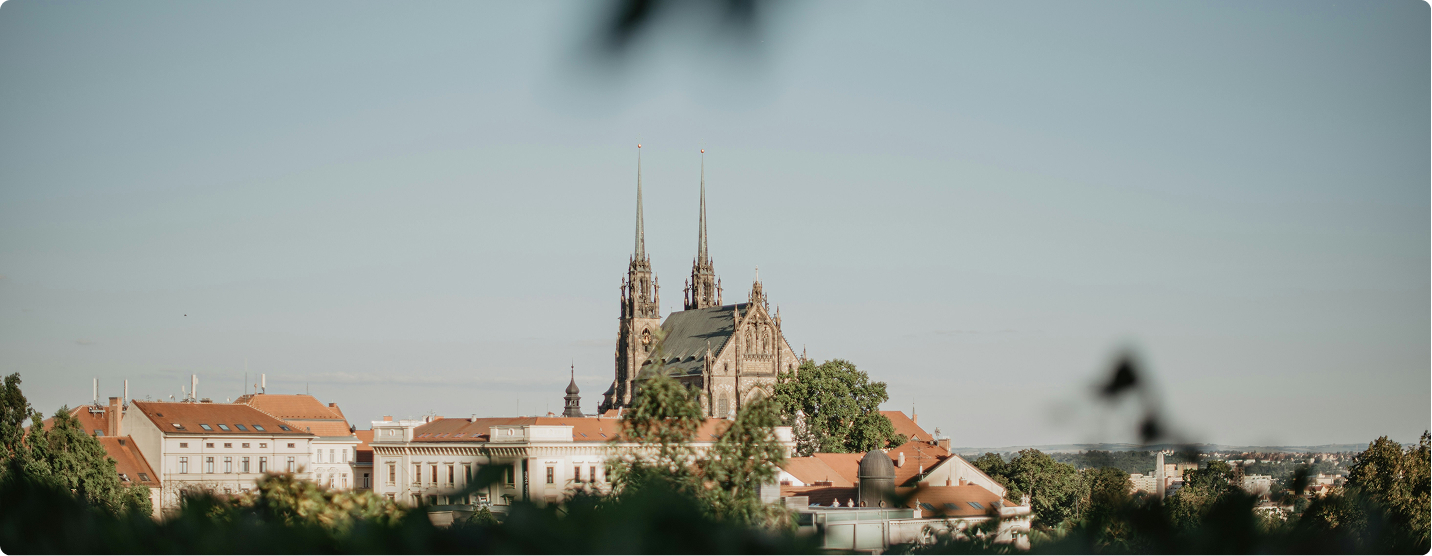
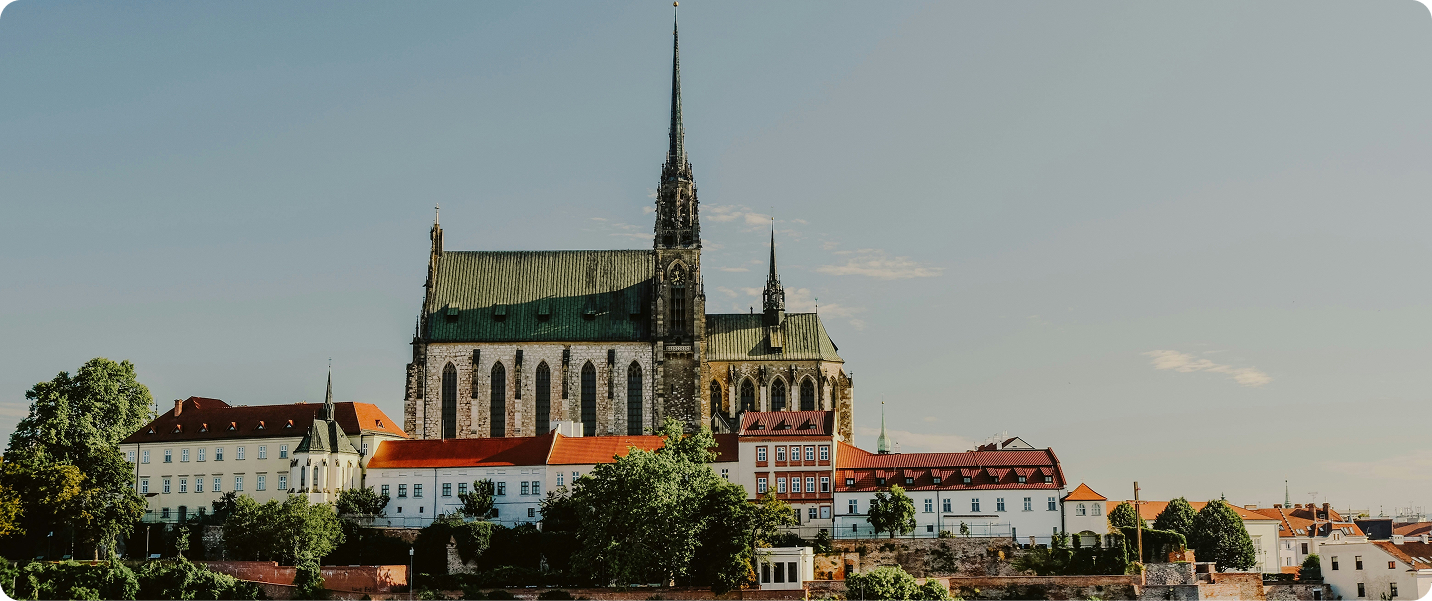
The Cathedral of Saints Peter and Paul is neither the oldest nor the tallest building in Brno, but it is the most distinctive. Its two Neo-Gothic towers were added between 1904 and 1909, and since then, they have formed the silhouette recognizable from every viewpoint. It stands on a rocky promontory that has been settled since the 12th century.
TIP: Petrov is the only cathedral in the Czech Republic that rings its noon chimes at eleven o'clock. If you want to experience this moment from inside, arrive about fifteen minutes earlier. After your visit, don't forget to stroll through Denis Gardens directly below the cathedral.
Denis Gardens
The oldest public park in the country
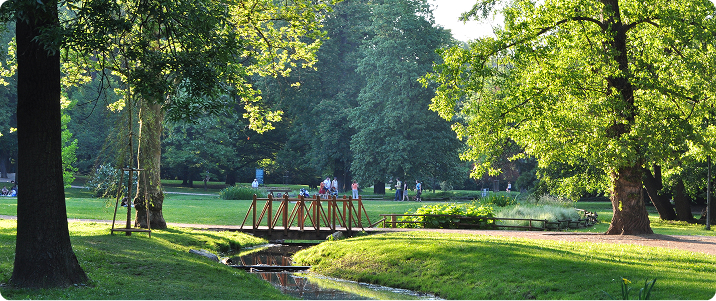
Denis Gardens were established between 1814 and 1818 as the very first public park in Moravia and Bohemia opened by public administration. The park stretches along the southern slope of Petrov and has two levels: at the bottom, a Neoclassical colonnade with a fountain and the 1818 Peace Monument obelisk, and at the top, observation terraces.
From the upper terrace, you can see Špilberk Castle, Old Brno, the Brno Exhibition Centre, the AZ Tower skyscraper, and on clear days, even Pálava, nearly 40 kilometers away. The best light comes about an hour before sunset, when the city's southern facades warm up to an orange glow.
.jpg)
Špilberk Castle
The castle that has seen it all
The castle above the city was founded in the second half of the 13th century, later transformed into one of the harshest Austrian prisons, and today houses the Brno City Museum. What makes Špilberk one of the most beautiful places in Brno is not just the castle itself, but also its ramparts and parks. Underground, you'll find casemates with an exhibition that's worth a stop even for people with only a passing interest in history.
TIP: The ascent from Husova Street takes about 15 minutes and is the most scenic. On the way, stop at the park by the lower terrace.
.jpg)
Lužánky Park
Brno's largest park with a pavilion by Förster
While Denis Gardens are a compact scenic garden above the city center, Lužánky serves as Brno's largest city park, covering approximately 20 hectares. It was established in 1786 from a former Jesuit garden, which Emperor Joseph II donated to Brno, and today it is one of Brno's most popular green spaces.
In the center of the park stands the Neo-Renaissance Pavilion from 1855, designed by Viennese architect Ludwig Förster, today known as the Casino, where balls, concerts, and exhibitions historically took place.
Lužánky serves as a daily retreat for Brno residents – people run here, practice yoga, play pétanque and tennis, and picnic on the grass in summer. It's an ideal spot for a short break during a city walk, a place in Brno to stroll without a long journey. The park is protected as a cultural monument and has held national monument status since 1849.
Villa Tugendhat
An icon that needs to be booked in advance
The Functionalist Villa Tugendhat in Černá Pole is the first modern architectural building in the Czech Republic to be inscribed on the UNESCO World Cultural Heritage List (this happened in 2001). It was built between 1929 and 1930 according to the design of Ludwig Mies van der Rohe, and since its reopening in 2012, it has been one of the main reasons why tourists and architects from all over the world come to Brno.
Important: Entry to the interior is only possible with a pre-purchased ticket, and it is usually advisable to book several months in advance. The garden and the exhibition on the technical floor are freely accessible during opening hours.
.jpg)
Brno's Villas
An architectural gem of the interwar era
Villa Tugendhat is not alone in Brno. During the interwar period, the city was one of the main centers of Functionalist architecture in Central Europe, and dozens of remarkable villas still stand here today – many of them designed by prominent architects of that era.
Among the most famous are Villa Stiassni in Pisárky, formerly known as the Government Villa; Villa Löw-Beer, directly adjacent to the Tugendhat garden; Jurkovič Villa in Žabovřesky with architect Dušan Jurkovič's own studio; and the Munk Villa by Ernst Wiesner.
TIP: You can find a complete database of Brno's interwar architecture from 1918–1945 in the Brno Architectural Manual at bam.brno.cz, featuring over 400 buildings with detailed descriptions, photographs, and a map.
.jpg)
Yellow Hill Water Reservoirs
Hidden Technical Monument
Beneath an unassuming park on Žlutý kopec (Yellow Hill) lie three underground water reservoirs dating from 1874, 1894, and 1917 – two brick and one concrete, with a total capacity of over 30 million litres. They served Brno as a drinking water supply until 1997, after which the city almost forgot about them, and in 2014, they were even slated for demolition. In 2019, the entire complex was declared a cultural monument.
The complete trio of reservoirs was opened to the public in March 2024. The brick vaults with arcades are among the most striking industrial spaces you'll see in Brno. You can visit with a guide (approx. 70 minutes) or individually with an audio guide (about half an hour). We recommend buying tickets online, as tours often sell out during peak season.
.jpg)
Cabbage Market and the Labyrinth Beneath It
Zelný trh (Cabbage Market) is one of the most beautiful places in Brno for a different reason than the reservoirs or Špilberk Castle. It's full of life – vendors sell fruit, vegetables, and flowers here from early morning. The square is dominated by the Baroque Parnas Fountain by Fischer von Erlach, completed in 1695. Behind it stands the Reduta Theatre, one of the oldest theatres in Central Europe, where, among others, a young Mozart performed in 1767.
Furthermore, beneath the square lies the Labyrinth under Zelný trh, a network of interconnected cellars, most of which date back to the Baroque period. It's an ideal stop on a rainy day or at midday when the sun starts to beat down on the surface.
.jpg)
Old Town Hall and the Brno Dragon
The passage of the Old Town Hall on Radnická Street is less conspicuous than most of the landmarks on this list, but it holds two iconic local legends: the suspended Brno Dragon (actually a stuffed crocodile, said to have been brought here in the 16th century) and the Brno Wheel, which, according to the story, was crafted by wheelwright Jiří Birko in a single day. Climbing the Old Town Hall tower is another viewpoint worth a stop.
.jpg)
Augustinian Monastery in Old Brno
If you enjoy exploring layers of history, stop by the Basilica of the Assumption of Our Lady and the Augustinian Monastery in Mendel Square. The monastery was founded by Queen Elizabeth Richeza as early as 1323. It was here that Gregor Johann Mendel conducted his pea experiments in the 19th century, from which modern genetics emerged – and in the Mendel Museum, which is part of the monastery, you'll encounter him in a more serene format than you might expect for the founder of an entire scientific field.
.jpg)
Brno Dam and Veveří Castle
A Trip Just a Few Minutes by Tram from the Centre
Among the most beautiful places in Brno accessible by public transport is the Brno Dam. Covering an area of 252 hectares, it was built on the Svratka River between 1936 and 1940, and regular boat transport has been operating here since 1946.
From Bystrc, you can reach the city centre by tram number 1 or 3, and the boat trip to Veveří Castle itself takes approximately 70 minutes. The entire route from Bystrc to Veverská Bítýška is just under 10 kilometres long.
Veveří Castle is one of the oldest and largest Moravian castles, with its core dating back to the 13th century. It offers guided tours, exhibitions, and numerous cultural events during the season. Combining the boat trip with a castle tour takes approximately five hours.
TIP: The boating season runs from April to October. Outside of the season, you can reach Veveří on foot via a trail around the dam, which leads along a rocky slope above the Svratka River. The path itself is beautiful and practically empty in winter.
.jpg)
How to Plan a Day Among the Best Places in Brno
If you only have one day in the city and are looking for the top places in Brno that can be explored on foot, stick to the axis Petrov – Denis Gardens – Cabbage Market – Freedom Square – Old Town Hall – Špilberk Castle. The route takes about a couple of hours, including stops, is entirely walkable, and you'll encounter several good cafes along the way.
If you have two days, dedicate the second day to hidden gems: in the morning, the Water Reservoirs on Yellow Hill (reservation in advance), then take a tram to Černá Pole for Villa Tugendhat (ideally reserve several months in advance), and in the late afternoon, the Ossuary at St. James's Church.
For architecture enthusiasts, a dedicated day exploring Brno's villas according to the Brno Architectural Manual is an option, followed by relaxation in Lužánky Park. For a relaxing day outside the city center, we recommend a boat trip on the Brno Dam to Veveří Castle and back.
For business travelers with limited time, a simple option is a one-hour walk through Denis Gardens around Petrov, offering architecture, views, and tranquility all in one loop. It's enough to soak in the city's atmosphere.
FAQ
What to definitely visit in Brno?
Among the most beautiful places in Brno that no visitor should miss are the Petrov Cathedral, Špilberk Castle, Villa Tugendhat, the Water Reservoirs on Yellow Hill, and the Cabbage Market. If you have extra time, add the Ossuary at St. James's Church. These five cover historical architecture, modern design, and lesser-known underground spaces.
Where to go for a walk in Brno?
The most beautiful walks in Brno lead through Denis Gardens around Petrov with views of the southern city and Pálava, through Špilberk Park with its avenues and viewpoints, Lužánky Park (the oldest public park in the Czech Republic), or around the Brno Dam. For a shorter loop, a walk from the Dialogue hotel through Denis Gardens to Petrov and back is sufficient. It takes less than an hour and covers the historic center.
What to visit for free in Brno?
Admission to Petrov Cathedral, Freedom Square with the Cabbage Market, Denis Gardens, Špilberk Park, Lužánky Park, and the grounds of Villa Tugendhat (garden and exhibition on the technical floor) is free. Views from Petrov, Yellow Hill, or Špilberk cost nothing. You can also walk through most of the historic center for free, including passing through the Old Town Hall with the Brno Dragon and wheel.
What is Brno known for?
Brno is the second-largest city in the Czech Republic and the center of Moravia. It is known for its functionalist architecture, notably Villa Tugendhat, Petrov Cathedral, Špilberk Castle, and the 1805 Battle of the Three Emperors on the Austerlitz battlefield. Internationally, Brno is associated with the BVV Brno Exhibition Centre, Moto GP, Mendel's research in genetics, and a dynamic gastronomic scene. Locally, the city is also known as the gateway to the Moravian Karst and Pálava.
zažijte Brno tak
jak ho mají rádi místní
Pár minut od centra, v domě s vlastním rytmem. Místo, kde máte město na dosah a zároveň klid na odpočinek.